Jean Baudrillard’s seminal work, Simulacra and Simulation, published in 1981, remains strikingly relevant in today’s hyper-mediated world. The book isn’t a light read; it’s dense, challenging, and requires careful consideration. But understanding its core arguments offers crucial insights into the nature of reality in the digital age. Baudrillard posits that our contemporary societies have become so saturated with signs and symbols – images, representations, and media – that the distinction between reality and simulation has completely collapsed. We no longer live in a world where signs refer to a pre-existing reality; rather, signs have become self-referential, creating a hyperreality that is more real than real.
Baudrillard describes four stages of the image’s relationship to reality. The first is a faithful image, where the sign clearly reflects reality. The second is a perversion of reality, where the sign masks and distorts reality. The third stage involves a mask that pretends to be real, even if there is no underlying reality. The final stage is pure simulacrum – a sign that bears no relation to any reality whatsoever, existing solely as a self-referential sign in a system of signs. This last stage is the defining characteristic of the postmodern condition that Baudrillard analyzes.
A key example Baudrillard uses is Disneyland. He doesn’t present it as a simple children’s amusement park; instead, it becomes a potent symbol of this hyperreality. Disneyland isn’t merely a representation of America; it actively creates a simulacrum of American ideals and values. By staging ‘reality’, Disneyland reveals the fundamental artificiality of the very concept of reality itself.
This idea of hyperreality extends far beyond theme parks. Baudrillard’s theories have been applied to various aspects of modern life, from media representations of war to the construction of social identities online. Consider the carefully curated online personas presented on social media platforms. These digital selves are often more ‘real’ and more carefully constructed than our offline lives, creating a hyperreal existence where appearances are more important than substance. His work prompts us to question the authenticity of our experiences in a world saturated with images and simulations.
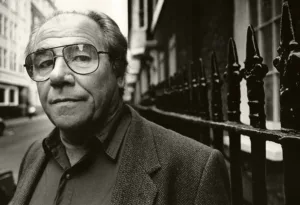
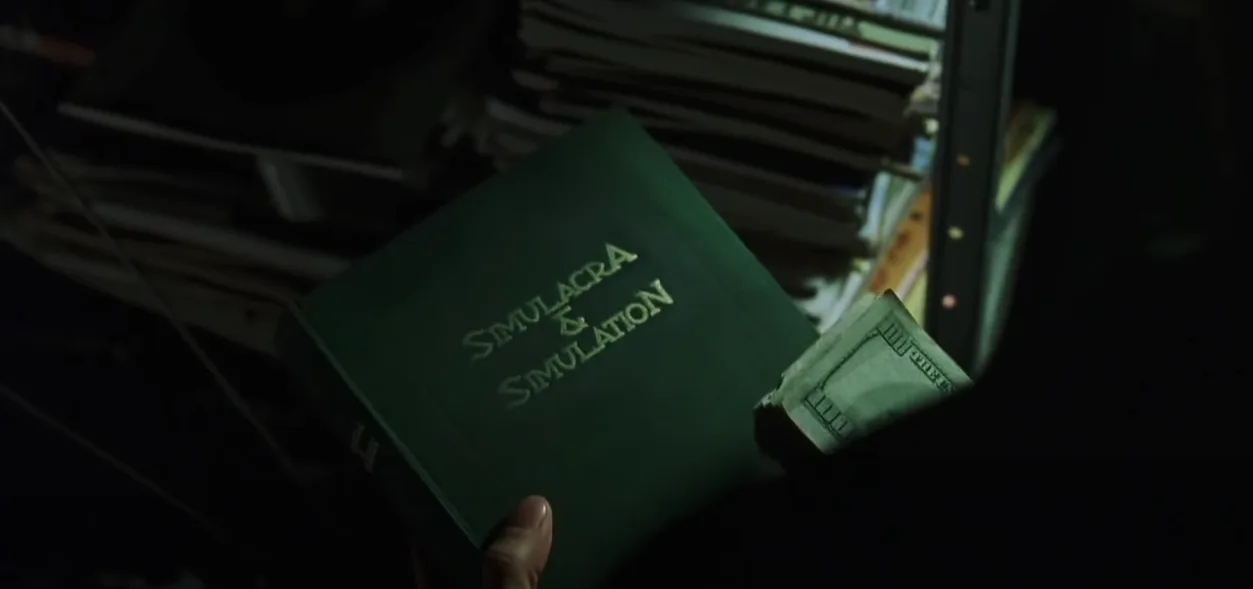
The directors of The Matrix, the Wachowskis, explicitly utilized Jean Baudrillard’s Simulacra and Simulation as a foundational reference for their groundbreaking film. They even made the book required reading for the cast, and famously featured a hollowed-out copy of it as a prop where Neo stores his illicit software. This direct homage underscores the film’s philosophical debt to Baudrillard’s core concepts of simulacra and hyperreality. The Matrix visually translates these ideas by presenting a meticulously crafted simulated world as the characters’ reality, embodying Baudrillard’s argument that in a hyperreal state, copies (simulacra) supersede the original, leading to a condition where the distinction between the real and the simulated blurs, exemplified by Morpheus’s stark “welcome to the desert of the real.”
Baudrillard’s work remains provocative and controversial. It forces us to confront uncomfortable truths about the nature of our perceptions and the increasingly blurred lines between the real and the simulated in the 21st century.
Last modified: June 15, 2025
Related Posts
Understanding Media: The Extensions of Man — Marshall McLuhan
Marshall McLuhan’s Understanding Media: The Extensions of Man was first
Sougwen Chung: Drawing with Robotic Systems
For Sougwen 愫君 Chung, a robotic drawing system is not
Akira — Katsuhiro Otomo
Akira is Katsuhiro Otomo’s monumental manga about power, adolescence and

Altered Carbon – Richard K. Morgan
Richard K. Morgan’s Altered Carbon isn’t just another cyberpunk novel;
Power and Progress: Our Thousand-Year Struggle Over Technology and Prosperity
Technology is often hailed as the engine of progress, promising